Cart
0
Introduction
If you’ve spent any time researching collagen supplements, you have likely run into the ultimate debate: is marine collagen better than bovine collagen? Many marketing campaigns claim that marine collagen is superior because it absorbs faster. But when you look closely at the science—and more importantly, at how the collagen is processed—the story changes completely.
Choosing between fish scales and beef bones isn't just about the source animal. It's about what your body actually needs to repair itself and whether you are consuming an isolated, heavily processed powder or a highly bioavailable whole food.
Which Absorbs Better: Marine or Bovine? (Quick Answer)
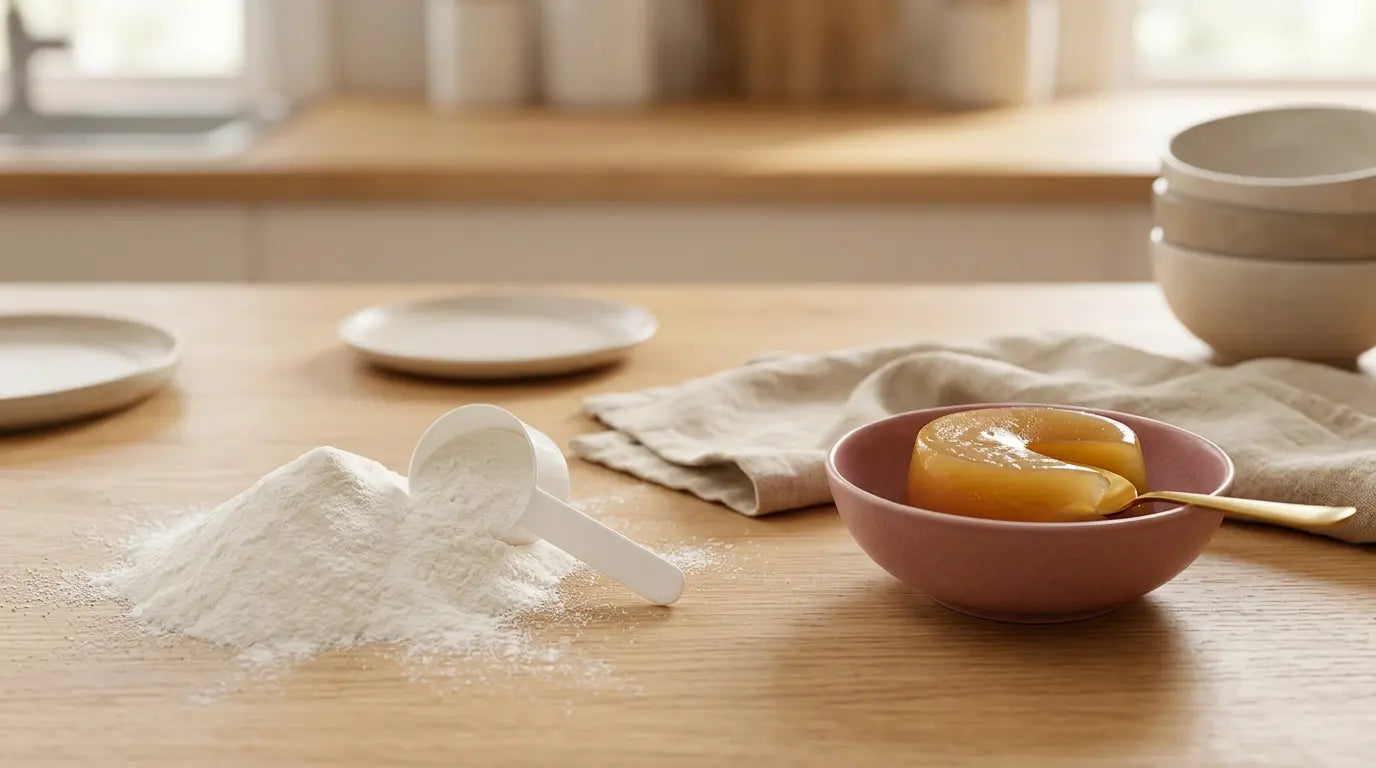
In powder form, marine collagen peptides are often marketed as having slightly smaller molecules, allowing for potentially faster initial absorption. However, absorption speed does not equal total bodily benefit. Bovine collagen provides a crucial combination of Types I, II, and III collagen, which are essential for comprehensive skin elasticity, joint mobility, and gut lining support. Furthermore, when bovine collagen is consumed as a slow-simmered, natural bone broth gel, its bioavailability rivals or exceeds that of highly processed marine powders because it retains its natural synergistic nutrients and gelatin.
The "Marine Absorbs Faster" Myth Explained
The claim that marine collagen is superior usually relies on one fact: in chemically hydrolyzed powders, fish-derived peptides are physically smaller. This means they can cross the intestinal barrier quickly.
But speed isn't everything. Marine collagen is almost exclusively Type I collagen. While Type I is great for skin, it lacks the Type III collagen required to build strong structural networks in your muscles and blood vessels, and the Type II needed for joint cartilage. By choosing marine collagen, you are often missing out on the comprehensive, full-body support that natural bovine sources provide.
Liquid Whole-Food vs. Processed Powders
The absorption debate changes entirely when you stop looking at factory-made powders and start looking at whole foods. To create marine collagen, fish skins and scales must undergo aggressive chemical and heat processing to remove the strong fishy odor and extract the peptides.
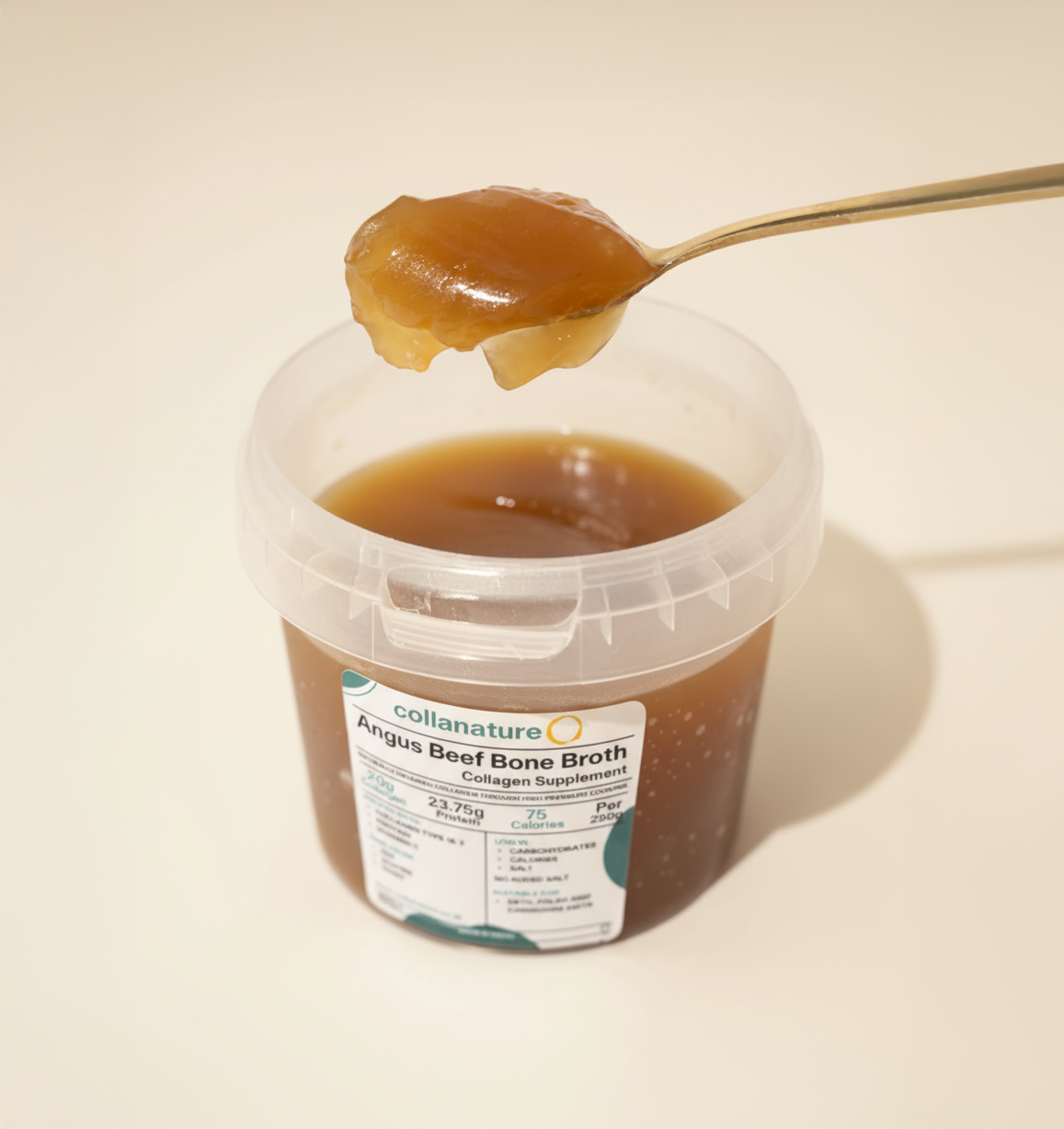
In contrast, premium bovine collagen can be extracted naturally through slow-simmering. By cooking beef bones and cartilage for 48 hours, a rich bone broth gel is created that naturally suspends the collagen alongside essential glycosaminoglycans and gut-soothing gelatin. Because this liquid format is recognized by the body as real food, it is digested and absorbed efficiently, completely bypassing the need for aggressive chemical hydrolysis.
Why Bovine is the Ultimate All-Rounder
If your goal is holistic health—meaning you want to support your skin's youthful appearance while also maintaining comfortable joints and a balanced digestive system—bovine is the undisputed winner.
Bovine bone broth naturally mirrors the collagen profile of the human body. It delivers a robust matrix of Type I, II, and III collagen. When taken in a highly concentrated, 100% natural liquid form—like a premium concentrate that delivers 4,000 mg of bioactive collagen per serving—it provides clinical-level structural support without the extreme processing associated with marine powders.
Frequently Asked Questions
Is marine or bovine collagen better for skin?
Both are excellent for skin because they both contain high levels of Type I collagen. However, bovine collagen also contains Type III, which works alongside Type I to maintain the foundational firmness and structure of the skin.
Does liquid bovine collagen absorb as well as marine powder?
Yes. While marine powders rely on chemical breakdown to be absorbed, natural liquid bovine bone broth is a highly bioavailable whole food. Its natural liquid or gel state allows the digestive system to easily process and utilize the intact nutrients without irritation.
Is marine collagen highly processed?
Yes. Because it is extracted from fish scales and skins, it requires significant industrial processing, including chemical hydrolysis, high heat, and deodorization, to become a flavorless, water-soluble powder.
Recent Post