


Cart
0
1. Is Convenience Costing You More Than You Think?
We live in a “grab-and-go” culture. It is incredibly tempting to buy a tub of neutral-tasting white powder that disappears into your morning coffee. However, convenience often comes with a trade-off in how close something is to real food.
Bone broth paste (concentrate) keeps more of what nutritionists call the “food matrix” – the natural web of collagen, gelatin, minerals and other compounds that come from slow-cooked bones and vegetables. Your body recognises this as food because it looks and behaves like food, not like a flavourless additive.
Collagen powder, by comparison, is an isolate. The protein has been separated from the rest of the original material through industrial processing, leaving you with a single nutrient rather than the broader context of a whole broth.
The “Orange vs Vitamin C” Analogy
Think of it this way: you can take a Vitamin C tablet, or you can eat a fresh orange. The tablet gives you a focused dose of one specific compound. The orange gives you Vitamin C plus fibre, water and many other plant compounds that all arrive together.
A traditional bone broth paste is closer to the orange: complex, slightly messy and very obviously food. A collagen powder is closer to the tablet: clean, convenient and isolated. Both can have a place in your routine, but if you want something that feels like eating rather than supplementing, the paste sits much closer to the “real food” end of the spectrum.
2. The Processing Reality: How Are They Made?
Hydrolysed collagen powder is typically made by taking animal hides or bones and treating them with heat and specific enzymes to break the long collagen chains down into much smaller fragments (peptides). The liquid is then dried – often by spray-drying – into a fine, shelf-stable powder.
Bone broth paste, by contrast, is usually produced with thermal reduction: heat and time. Bones are simmered with water (and often vegetables) for many hours, then the liquid is gently reduced to make it more concentrated. The protein structure changes naturally from collagen to gelatin, but it is not broken down into tiny peptides or separated from its original broth context.
Stable Powder vs “Living” Food
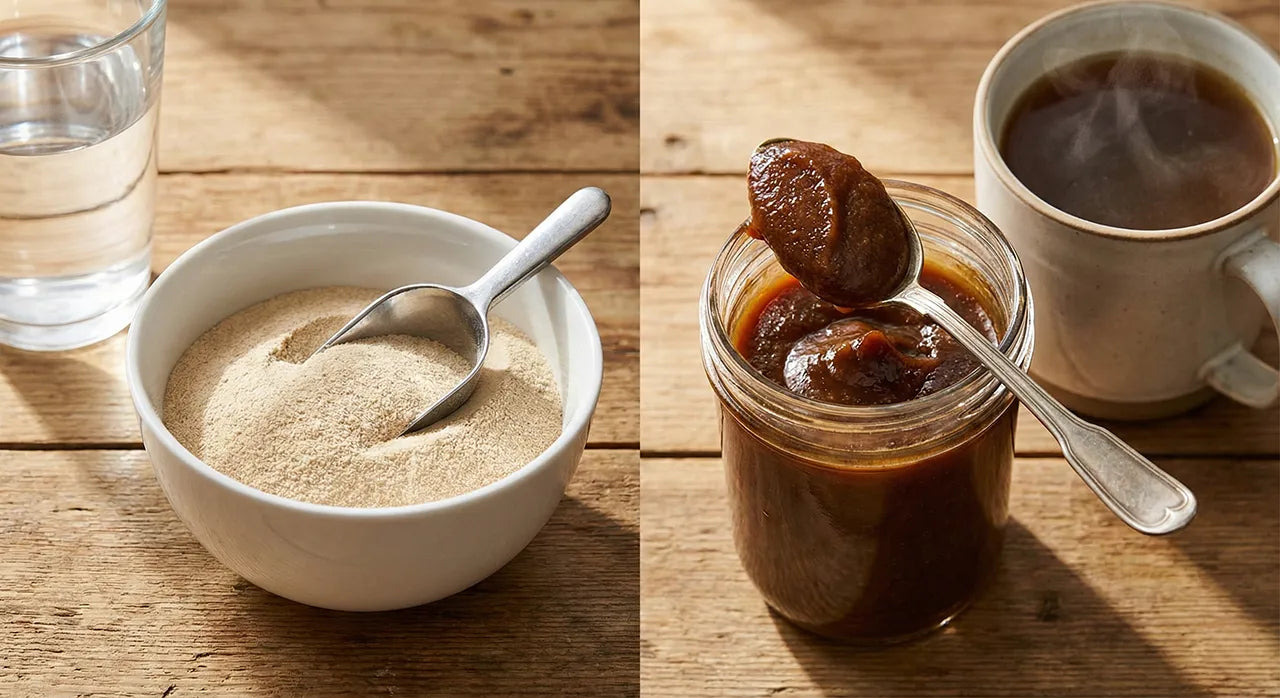
Open a tub of standard collagen powder and you will see something very consistent: it is fine, dry and almost odourless. It is designed to be extremely stable on a shelf, to flow easily through machinery and to disappear into drinks without changing their taste too much.
Open a jar or pack of concentrated bone broth and the experience is different. It is dark, rich and changes texture depending on the temperature – it can be soft at room temperature and wobble like jelly when chilled. It smells like slow-cooked meat and stock. Once opened, it needs to be kept in the fridge and used within the timeframe suggested on the label, because it behaves like a real food, not like a dry powder.
3. The “Food Matrix” Effect: Why Synergy Matters
Bioavailability – how easily your body can use a nutrient – is not only about making particles as small as possible. It is also about the context they arrive in. A bowl of bone broth delivers collagen and gelatin alongside naturally occurring minerals and small amounts of fats from the bones and connective tissue.
When collagen is stripped down to make a pure powder, much of that broader context is removed. A concentrated bone broth paste retains components that come directly from the bones and vegetables used in the pot, including naturally occurring minerals such as potassium, magnesium and phosphorus from the bone matrix and cooking liquid. These are not “added back in”; they are part of the original broth.
What Gets Left Behind
Collagen powder focuses almost entirely on protein. Bone broth paste offers collagen and gelatin within a liquid that still contains bone-derived minerals and the taste and aroma of real stock. For people who prefer to get more of their nutrition from recognisable foods, this “food matrix” effect is a key difference between the two formats.
4. Satiety and Ritual: The Hidden Advantages of a Warm Mug
There is more to feeling nourished than just hitting a gram target for protein. The way you consume something – temperature, texture and taste – also influences how satisfied you feel afterwards.
Drinking a warm mug of savoury broth engages multiple senses: you smell it, taste it and feel the heat. For many people, that combination feels more like having a small meal than simply adding a scoop of powder into a coffee or smoothie. It can make the experience of taking collagen feel more substantial and grounding.
The “Comfort” Factor
There is also a psychological side. Sipping a hot, savoury drink tends to slow you down for a few minutes. It slots easily into an evening wind-down or a mid-day break and can become a small self-care ritual instead of something you rush through on the way out the door.
Collagen powders, on the other hand, excel at convenience. They disappear into busy mornings with almost no effort. Many people ultimately find that using both – powder when speed matters and broth when they have time to sit – gives them the best of both worlds.
5. Frequently Asked Questions
1. Is powder bad for me?
No. A good-quality hydrolysed collagen powder is generally considered safe when used as directed. The main difference is that it is a single, isolated ingredient, whereas bone broth paste behaves more like a food – with collagen and gelatin sitting inside a broader broth made from bones and vegetables. Think of powder as a focused “booster” and broth as a more complete culinary base.
2. Which one absorbs faster?
Collagen powder tends to dissolve and be absorbed more quickly because its proteins are cut into tiny peptides. Bone broth pastes and gels deliver collagen in the form of gelatin, which can break down more gradually. Some people like the speed and simplicity of powder; others prefer the more sustained, satisfying feel they get from a warm broth.
3. Does the paste taste strong?
Yes, it usually has a pronounced savoury flavour, similar to a rich roast beef gravy or concentrated stock. That is a sign that you are dealing with a real bone-based broth. Many collagen powders, by contrast, are processed to be very neutral in taste and smell so they can disappear easily into drinks.
4. Why does the paste have a shorter shelf life?
Bone broth paste is a moist, concentrated food, not a dry powder. Once opened, it should be kept in the fridge and treated more like a fresh stock or sauce. Always follow the storage and “use within” guidance on the label. Collagen powders have a much lower water content, which is why they typically stay stable for longer in a cupboard.
5. Can I use both?
Yes. Many people combine formats. For example, you might enjoy a warm collagen broth in the evening as a savoury ritual and use a neutral-tasting powder in your morning smoothie when you are short on time. It is less about choosing one “winner” and more about deciding which tool suits each moment of your day.
6. Do collagen powders contain anti-caking agents?
Some do. To keep powders flowing smoothly through manufacturing equipment and to stop them clumping, producers may add small amounts of flow agents such as silicon dioxide or magnesium stearate. If this matters to you, check the ingredient list and choose products – powder or paste – whose labels align with your preferences.
Final Thoughts
Your body has spent thousands of years dealing with food first and isolated ingredients second. Collagen powders are useful tools, especially for busy days – but they live at the “supplement” end of the spectrum. Bone broth pastes sit much closer to the “food” end: textured, aromatic and recognisably derived from real bones and vegetables.
Rather than trading everything for convenience, you can build your routine around complex, nutrient-rich foods and layer powders on top when they make sense for your lifestyle.
Shop Collanature: Original (Unflavoured) or Wild Berries.


Recent Post


