Cart
0

1. It’s Not Just About Posture
We often blame our office chairs or heavy lifting for back pain, but there is a hidden biological factor that is frequently overlooked: desiccation (drying out). Your spinal discs are essentially hydraulic shock absorbers. When they are fully hydrated, they cushion the vertebrae and allow for pain-free movement. When they become dehydrated—a common age-related process often labelled Degenerative Disc Disease—they lose height and flexibility, increasing the risk of nerve compression.
The "Dry Sponge" Reality
Imagine a wet sponge between two bricks. You can press the bricks together, and the sponge bounces back. Now imagine a dry, hard sponge. If you press the bricks, the sponge cracks and the bricks grind. Many people suffering from chronic stiffness are walking around with "dry sponges."
While physiotherapy corrects the mechanics (the bricks), nutrition also plays a role in supporting the sponge. Without the right raw materials, stretching alone will struggle to support the rehydration of a dried-out disc.
2. Anatomy of a Disc: The Jam Doughnut
To understand how bone broth helps, you need to picture a jam doughnut. The outer ring of the spinal disc (Annulus Fibrosus) is made of tough, rigid Type I Collagen—the same collagen found in beef bone broth. The inner core (Nucleus Pulposus) is like the jam; it is a jelly-like substance made of Type II Collagen and water, held together by proteoglycans (built from glycosaminoglycans such as hyaluronic acid).
Feeding the "Jam"
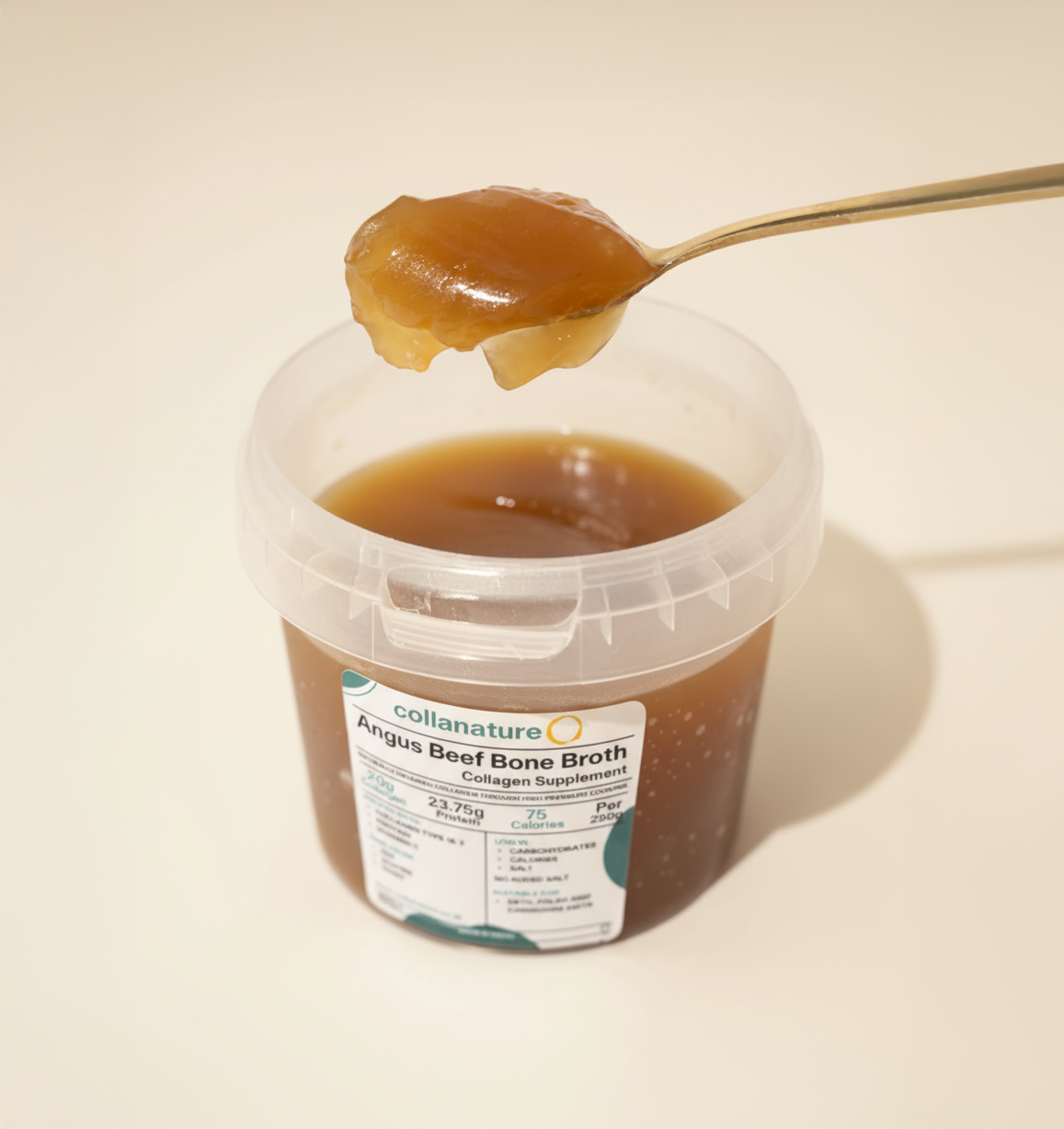
The inner core is roughly 80% water, but it needs a matrix to hold that water in place. That matrix is made of GAGs (Glycosaminoglycans). Collanature Angus Bone Broth is a natural source of collagen plus bioactive nutrients such as hyaluronic acid, chondroitin and glucosamine, which belong to the glycosaminoglycan family.
By consuming the broth, you are giving your body structural proteins and hydration-supporting compounds it can use to maintain the outer ring and support the water-holding capacity of the inner core.
3. Why Drinking Water Isn't Enough
You cannot always hydrate a disc simply by drinking more tap water. Part of what keeps water inside tissues are "binding agents" in the extracellular matrix—collagen fibres and glycosaminoglycans like hyaluronic acid—that act like a sponge. Without a healthy matrix, water is harder for the tissues to hold onto.
This process is called imbibition. Because spinal discs have a very limited direct blood supply, they rely on a gentle pump mechanism created by movement and alternating pressure to draw nutrients and fluid in.
The high proteoglycan and GAG content of the nucleus pulposus is what creates most of the osmotic pressure inside the disc, helping it pull in and retain water. Collagen provides the scaffolding for this matrix, while GAGs act like tiny water magnets, working together to keep the "sponge" resilient.
4. The "Morning Height" Phenomenon
Did you know you are taller in the morning than in the evening? During the day, gravity squeezes some of the water out of your discs, and many people lose around 1–2 cm in height by bedtime. At night, when you lie down, the pressure is released, and the discs draw fluid back in like a sponge—that is when much of the natural rehydration and repair happens.
Taking a serving of Collanature Bone Broth in the evening provides collagen and amino acids such as glycine and proline right before this repair cycle begins, so your body has these building blocks available while your discs naturally "refill" during sleep. It is not a magic fix, but it can be one useful part of a back-friendly routine that also includes movement, posture and medical care where needed.
5. Frequently Asked Questions
Can collagen cure a herniated disc?
No nutritional product can "cure" a structural rupture (herniation). Treatment for disc problems should always be guided by a qualified healthcare professional.
What collagen-rich foods like bone broth can do is supply amino acids your body uses to build and maintain connective tissues in general, as part of a broader recovery and prevention strategy. They complement, but do not replace, medical treatment or rehab.
Is it safe to take with painkillers?
Bone broth collagen is a whole food, not a drug, and most people can enjoy it alongside common painkillers. However, if you are taking medication regularly, have a diagnosed condition, or are under medical supervision, you should always check with your doctor or pharmacist before changing your routine.
This article is for general information only and is not a substitute for medical advice.
Will it help with Sciatica?
"Sciatica" describes pain along the sciatic nerve, often related to a disc or joint issue, but there are several possible causes. Collagen or bone broth cannot directly treat or cure sciatica.
Some people choose collagen-rich foods to support overall joint and connective tissue health while they follow a treatment plan from their clinician. Any persistent back or nerve pain should always be assessed by a healthcare professional.
Why is Bovine better than Marine for backs?
Bovine bone broth naturally contains a mix of Type I, II and III collagen, reflecting the collagen types found in bones, cartilage, ligaments and fascia. Marine collagen is mostly Type I.
If your goal is to support a wide range of connective tissues around the spine (discs, ligaments, fascia), many people prefer bovine bone broth because it more closely resembles that natural profile. That does not make marine collagen "bad"—it just means bovine may be a better match for whole-back support.
5. How long does it take to feel a difference?
Spinal discs and connective tissues have a very slow metabolism. Unlike skin (which renews roughly every 4 weeks), deeper tissues can take 3–6 months to show noticeable changes.
Collanature’s own guidance—and many clinical collagen studies—use a 90-day window as a sensible minimum for evaluation. Consistency matters: whatever you choose, give your body time, and always combine nutrition with appropriate movement, ergonomics, and professional care.
Final Thoughts
Your spine carries you through life. Do not let it dry out. By combining proper hydration, regular movement, and the structural support of collagen-rich foods like bone broth, you help your back maintain the resilience it needs to stay flexible over time.


Recent Post